


Journal Club: Medicine
4.447.00 Reviews
App Specs
- Version
- Varies with Device
- Updated On
- License
- $6.99
- Downloads
- 10,000+
- Developer
- Peripheral Brain, LLC
- Categories
- Medical
- Platform
- Android
Screenshots
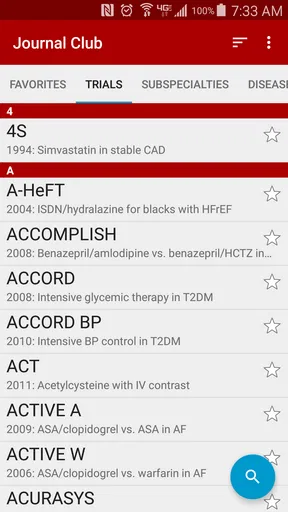
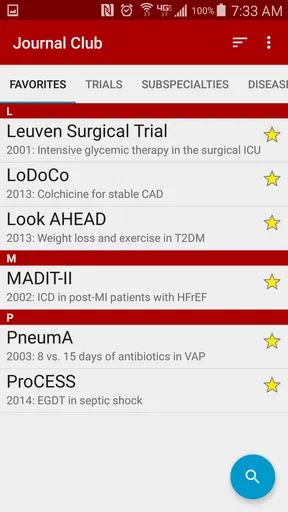

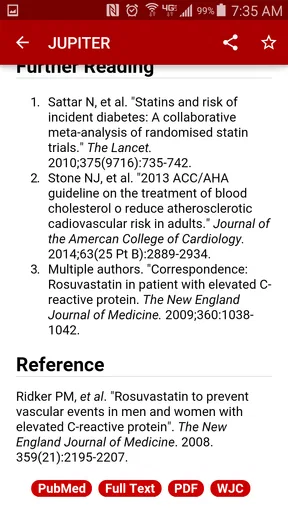

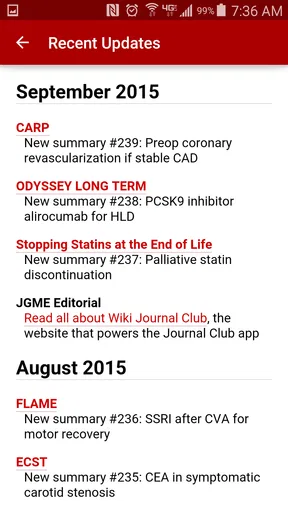
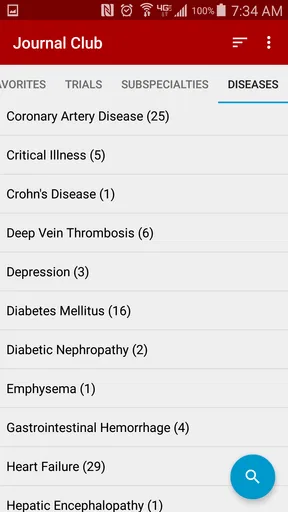
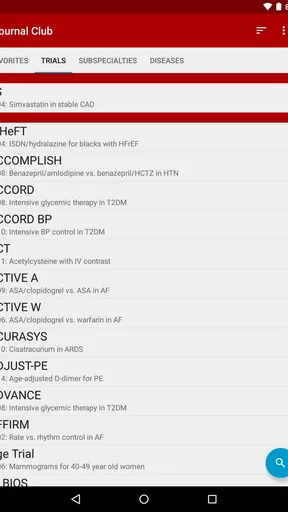
 Analysis by AppCompare
I approached Journal Club: Medicine as a focused reading tool rather than a general medical reference. Developed by Peripheral Brain, LLC, this paid medical app is built around the idea of keeping internal medicine literature close at hand. That narrow purpose is its main appeal: instead of presenting itself as a broad patient-information service, it aims at readers who want to spend time with journal material and use that reading to support study, discussion, or professional reflection.
My overall impression is that it makes the most sense for a medical student, resident, physician, or serious learner who already understands the language of internal medicine. It is less convincing as a first stop for someone looking for plain-language explanations of symptoms or conditions. The app has an average rating of 4.4 from around 291 ratings, and its 10K-plus installs suggest that it has found a modest but recognizable audience. I would still judge it by fit rather than popularity, because a literature-focused app can be useful to one reader and unnecessarily demanding to another.
How the reading experience works for different users
I’d use this section to consider how the same literature-centered approach can feel different depending on a reader’s training, reading habits, and accessibility needs. The key is to choose a session that matches your goal and notice where the app helps you stay focused—or where another format would make the material easier to work with.
Readability and navigation for sustained medical reading
The most important accessibility question here is not whether the app contains a long list of visual settings. It is whether the reading experience helps a person locate, understand, and return to medical literature without unnecessary effort. In my view, the product’s focused identity is helpful. A tool dedicated to internal medicine literature gives the reader a clearer mental model than a large, mixed medical app filled with calculators, symptom checkers, patient handouts, and unrelated news.
That focus can reduce cognitive switching. If I open it with a specific learning goal, such as preparing for a journal club conversation or reviewing a topic after a clinical teaching session, I am not asking the app to do ten unrelated jobs. The narrower purpose encourages a more deliberate workflow: choose a subject, read closely, note what changes my understanding, and then compare the material with what I already know.
For readers with attention difficulties, this distinction matters. A general medical platform may offer more content but also create more opportunities to drift into unrelated sections. A literature-centered tool can be easier to use when the task is simply “read and think.” That said, focused content is not automatically easy content. Internal medicine papers often contain dense terminology, abbreviations, tables, and statistical language. The app may make the material available, but the reader still needs enough background to interpret it responsibly.
I would approach the interface with a practical habit: decide what I am trying to answer before opening a paper. For example, I might ask whether a study changes diagnostic reasoning, affects treatment selection, or mainly adds background knowledge. This turns passive scrolling into a manageable reading session. It is also a useful strategy for users who become overwhelmed by dense professional material, because it gives each session a defined stopping point.
Worth Reading Before You Choose

Flipboard Shows What News Apps Must Do Beyond the Feed

Switching to Android Auto Means Rethinking Your Driving Routine

Google Calendar Makes a Crowded Week Easier to Manage

Ludo King Makes the Most of the Minutes Between Plans

Baby Panda World Brings Quick Play to Modern Phones, but Its Game Library Feels Busy

ESPN’s Live Game View Makes Following Close Games Easier
Another helpful approach is to separate quick scanning from close reading. On a first pass, I would look for the question, population, intervention or exposure, comparison, and outcome. On a second pass, I would examine the parts that matter to my purpose. This is not a feature claim; it is a way to use a literature app more accessibly. It prevents a reader from treating every paragraph as equally urgent and makes the product more workable on a small phone screen.
The app’s age also deserves attention. It was released on March 9, 2013, which places it in an earlier generation of mobile medical tools. That does not make it unusable, but it does shape my expectations. Readers accustomed to modern interfaces, highly refined search systems, adjustable reading modes, or seamless cross-device workflows may find the experience less polished than newer alternatives. For someone who values straightforward access over visual novelty, that may be acceptable. For someone who depends on a carefully optimized reading environment, it is a reason to test it before committing.
Motor and sensory considerations in everyday use
Medical reading often happens in imperfect conditions: standing between tasks, holding a phone in one hand, or trying to review a passage while tired. Those situations expose practical accessibility issues that are easy to miss during a short store-page glance. A literature app is more comfortable when its controls do not demand precise tapping and when the text remains usable without constant zooming or repositioning.
I would be cautious about recommending this app solely on the promise of convenience. A small screen can make long articles tiring, especially for readers with low vision, visual fatigue, or difficulty maintaining focus across dense blocks of text. The medical subject matter adds another layer: unfamiliar abbreviations and closely packed information increase the cost of every visual adjustment. If reading comfort depends on large text, strong contrast, screen magnification, or a particular text-to-speech setup, I would test the app directly with those tools before relying on it for regular study.
For users with motor limitations, the best workflow is likely one that minimizes repeated navigation. Rather than opening the app for every tiny question, I would collect a short list of topics and review them in one planned session. This reduces the number of taps and the need to repeatedly locate the same material. It also makes sense to use the phone’s own accessibility controls where appropriate, since those system-level tools may be more dependable than expecting every medical app to provide a complete set of adjustments.
Readers with hearing loss may find the app’s text-centered purpose more suitable than an audio-first medical service, because the core activity is reading rather than listening to spoken explanations. However, that should not be confused with a guarantee that every part of the experience works equally well with assistive technology. The practical question is whether the device can expose the relevant text and controls clearly enough for the individual user. I would treat a short trial as essential for anyone who depends on a screen reader, magnification, switch access, or customized display settings.
People with dyslexia or other reading differences may appreciate being able to work through material at their own pace, but journal writing remains demanding even when the presentation is clean. I would use a two-stage method: first identify the study’s main claim in my own words, then return to the technical details. That method lowers the pressure to decode every sentence perfectly on the first attempt. It also helps distinguish a genuinely important finding from a complicated description of methods.
Situational access for students, clinicians, and independent learners
The strongest use case is a planned reading moment. Imagine a resident with a short break before a teaching discussion. Rather than searching the wider internet and sorting through patient pages, advertisements, and unrelated summaries, the resident opens a tool centered on internal medicine literature, reviews a selected topic, and writes down two questions for the group. The value is not just speed. The focused setting can make the preparation feel more intentional.
A medical student could use it after a lecture to move beyond memorized facts. I would not try to read an entire paper in one sitting while commuting or walking between buildings. Instead, I would use a quiet portion of the journey to identify the clinical question, then save deeper interpretation for a place where concentration is possible. That distinction is especially important for users who experience motion sensitivity, visual strain, or reduced attention in noisy environments.
For a physician, the app may fit best into professional development rather than urgent decision-making. Literature reading can broaden clinical thinking, but a mobile journal tool should not become a substitute for current institutional guidance, specialist consultation, or a full appraisal of evidence when a patient decision is time-sensitive. I would use it to generate questions and maintain familiarity with internal medicine discussions, not to make a high-stakes decision from a hurried glance.
Independent learners face a different challenge. The app’s medical focus may be attractive, but internal medicine literature is not written like a beginner’s course. Someone without formal training could easily mistake a study result for a universal rule or miss important limitations in the population and methods. If that describes you, I would choose a structured educational resource first and use this app later as a supplement, ideally with a textbook, course, or knowledgeable guide nearby.
Situational access also includes financial access. The app costs $6.99, so it is not a free experiment for every reader. I see that price as easier to justify for someone who will return to medical literature regularly than for a casual user who only wants an occasional explanation of a condition. Students should think about frequency of use: if it supports repeated study sessions, the purchase may feel reasonable; if it will be opened once or twice, a library resource or existing institutional access could be the better choice.
The Everyone age rating makes the app broadly available from an age-classification perspective, but that label should not be mistaken for beginner-friendly medical content. A young reader may be allowed to access it while still finding the vocabulary and evidence interpretation too advanced. In practice, intellectual readiness matters more than the age label for deciding whether the material will be useful.
Remaining barriers and where another option may win
The clearest limitation is the gap between access to literature and understanding literature. An app can put professional material within reach, but it cannot remove the need for context. Readers may need help with study design, bias, confidence intervals, clinical relevance, or the difference between association and causation. If I wanted explanations written for patients, visual teaching aids, medication reminders, or a broad collection of clinical utilities, I would choose a different medical app.
There is also a trade-off between specialization and flexibility. The narrow internal medicine emphasis is useful when it matches the reader’s goals, but it may feel restrictive for someone studying surgery, pediatrics, nursing fundamentals, public health, or general wellness. A broad medical reference would be more practical for users who regularly move across specialties. This app is at its best when the subject boundary feels like a helpful filter rather than a missing feature.
The older release date creates another possible barrier for users who expect contemporary mobile habits. I would not assume that a product with a long history automatically offers the same level of interface refinement as a recently built reading platform. Anyone who depends on smooth navigation, modern display behavior, or a highly customized reading setup should evaluate the actual experience on their device before making it part of a daily routine.
Readers who need current evidence should also think carefully about workflow. Medical literature changes, and a journal-reading app is only as useful as the material available through its own system and the reader’s ability to judge relevance. I would pair it with a trusted current source when the purpose is clinical practice. For exam preparation, I would pair it with the syllabus and core references rather than assuming that interesting journal material covers what an assessment requires.
Privacy and comfort can be practical concerns even when they are not the main selling point. I prefer to read sensitive professional material in a private setting and avoid using a phone as the only place where important notes live. If a particular article leads to a useful insight, I would record that insight in a separate study system with the date and topic, rather than relying on memory or expecting the app to serve as a complete knowledge-management tool.
Finally, not every reader benefits from a text-heavy workflow. Someone who learns best through diagrams, short videos, interactive cases, or spoken explanations may find the experience slow and effortful. That is not a defect in the idea of a journal club; it is a mismatch between format and learning style. In that situation, I would use this app only as a source for deeper reading after learning the topic through a more visual or guided resource.
An inclusive verdict for the right kind of reader
My recommendation is deliberately specific. I would suggest Journal Club: Medicine to a reader who wants a compact way to engage with internal medicine literature, already has enough medical background to handle professional writing, and is comfortable building a personal reading routine. The product’s focused purpose can support people who prefer a quieter, less distracting study experience, and its text-based emphasis may suit those who need to read rather than watch or listen.
I would not recommend buying it blindly to someone seeking a patient-friendly medical guide, an emergency reference, a universal accessibility solution, or a complete learning platform. The price makes a trial especially sensible for casual users, while the older release date makes direct testing important for anyone with specific visual, motor, or assistive-technology needs.
My most useful advice is to judge it through one realistic session before deciding whether it belongs in your routine. Choose a topic you already recognize, set one question, read in the environment where you normally study, and notice whether the text and navigation help or hinder you. Then ask whether you can explain the article’s main result, its limits, and its practical relevance. If the app helps you do that with less friction, it is serving its purpose.
After using it this way, I see the app as a specialized doorway rather than a complete medical library or a replacement for professional judgment. That is a modest role, but a valuable one. For the right reader, the real strength is focused access to serious internal medicine reading without pretending to be everything at once. Its inclusive value depends less on a universal feature checklist and more on whether its concentrated format, demanding content, and device-level reading tools align with the person using it.
Pros
- Focused on concise
- clinically relevant medical journal summaries.
- Useful for discovering new research across multiple medical specialties.
- Can support evidence-based learning and professional development.
- Saves time compared with reading every full research paper.
- A practical reference tool for students
- residents
- and healthcare professionals.
Cons
- Summaries may omit important methods
- limitations
- or statistical details.
- Not a substitute for reviewing the original study or clinical guidelines.
- Medical content can be difficult for users without healthcare training.
- Coverage and update speed may vary between specialties and publications.
- Some features or content may require an account or paid access.
FAQs for Journal Club: Medicine
What is Journal Club: Medicine and who is it designed for?
Journal Club: Medicine is an educational app focused on helping healthcare professionals and medical students review and discuss recent clinical research. It is especially useful for physicians, residents, students, and other healthcare workers who want a convenient way to follow medical literature, prepare for journal club meetings, and improve their understanding of evidence-based medicine. It should be considered a learning and discussion resource, not a replacement for formal training or clinical supervision.
What kind of medical content can I find in Journal Club: Medicine?
The app generally centers on medical journal articles, research summaries, and topics suitable for critical appraisal and professional discussion. Depending on the available content and updates, users may encounter studies from different specialties, clinical trials, reviews, and research addressing diagnosis, treatment, and patient care. The usefulness of each article depends on its quality, publication date, and clinical context, so readers should consult the original paper and current guidelines before applying any information.
Can Journal Club: Medicine be used to make patient-care decisions?
No. Journal Club: Medicine is best used for education, literature review, and discussion rather than as a direct clinical decision-making tool. Research findings may have limitations, and an article may not apply to every patient, setting, or healthcare system. Always evaluate the original evidence, consider the patient’s individual circumstances, and follow current professional guidelines. Medical decisions should be made by qualified healthcare professionals using appropriate clinical judgment.
Is Journal Club: Medicine free to download, and are there in-app purchases?
The app’s download model, subscription options, and available features may vary between Android and iOS and can change with future updates. Some functions or content may be available without payment, while advanced tools, additional resources, or premium access could require a purchase. Before installing, check the official store listing for the current price, subscription terms, renewal conditions, and whether your device and operating-system version are supported.
Does the app require an internet connection or account to work properly?
Some features of Journal Club: Medicine may require an internet connection, particularly when loading new articles, synchronizing content, accessing discussion functions, or receiving updates. An account may also be needed if the app offers saved preferences, personalized reading lists, or community participation. Offline availability can depend on the specific version and downloaded material. Review the app’s permissions and privacy information before registering or granting access.


